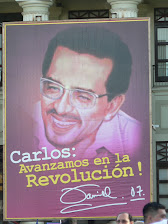
Sunday, March 9, 2008

NELSON P. VALDÉS on "Cuba After Fidel "

Raúl Castro, Team Work and the Search for the Spirit of Capablanca


This is an important article, in my opinion, not just because of the credtials of the author (a widely respected US-based Cuban studies scholar and researcher) but also for its understanding of the complexities and evolution of political life in Cuba over the last five decades since the 1959 victory.

The article is taken from the March 1/2 edition of Counterpunch
http://www.counterpunch.org/valdes03012008.html

Felipe Stuart

Managua

Note: the reference to Capablanca in the heading is to José Raúl Capablanca, Cuban
born, world chess champion (1921-1927).


Cuba After Fidel

By NELSON P. VALDÉS

"If there is food for the people, risks do not matter"

Raúl Castro. 09/18/1994

"We will do what is best for each sector and place, and we will not unleash processes that could escape the control of the socialist State."

Carlos Lage. 12/19/1994


"I strongly believe that the answers to the current problems facing Cuban society ... require more variables for each concrete problem than those contained in a chess game."

Fidel Castro. 02/18/08

>* * * * * *<

The "Cuba experts" pontificating in the U.S. press claim that Raúl Castro, who replaced his famous brother in the new government, has appointed a hard-line anti-reformer to be the next person in line to succeed him. Why was José Ramón Machado Ventura selected instead of Carlos Lage? Have the "hardliners" won? Are the "reformers" in retreat? Is Machado Ventura more important to Raúl than Carlos Lage? What evidence, in fact, is there that political and economic differences exist within the new Cuban government? These are the wrong questions. Instead, we ought to pay attention to the assembled political team, their personal comparative advantages, experiences and functions that they could perform. In the Cuban political context, political people cannot be separated from their overall political environment and institutional linkages.

However, since foreign journalists and some scholars have made an issue of the selection of Machado Ventura over Carlos Lage, it is useful to discuss the service history of each.

Machado Ventura was born in 1930. 19 years older than Lage. Machado Ventura is one of the few educated people that fought with Raúl in the guerrillas. He was a founder of the Frank País Second Front guerrilla region. He served as the guerrillas' physician. By 1959 he had become comandante , the highest rank within the Cuban guerrilla forces. Lage was 8 years old when the guerrilleros seized power.

Machado Ventura became minister of health at age 29 (1960-1967). He helped [helped to?] conceive, create and run the Cuban medical system that made the island famous. He excelled in organizational skills. Carlos Lage graduated as a physician but did not have a military background.

Machado Ventura was a founder of the Communist Party (PCC ) in 1965; Lage at the time was 14 years old.

By 1968, because of his organizational skills, Machado Ventura was given the responsibility of cleaning up the serious problems that the Cuban Communist Party confronted in Matanzas province. (At the time a pro-Soviet faction, led by Aníbal Escalante, had engaged in political and intelligence activities that the Castro brothers considered dangerous and treacherous.) Also, in 1968 he had become a member of the Central Committee. From that point on, Machado Ventura's work concentrated on the one party organization. In 1971, he had the post of first party secretary of Matanzas Province. Then he had the responsibility of doing a similar work rebuilding the party system in Havana. In other words, he did NOT remain within the ministry of the Armed Forces but left it in order to be a civilian organizing the Communist Party ranks. He had the political credentials of having participated in the guerrilla war. Since 1974 he has been the person in charge of the organization department of the PCC.

He had a fundamental role in the institutionalization of the revolutionary process initiated by Raul Castro in 1976. Machado Ventura was the one responsible for implementing that process, first in Matanzas and then in the rest of the country. He was brought into the Political Bureau and the Secretariat of the
Communist Party owing to his work in the province of Matanzas. In 1976, Machado Ventura was elected to the new National Assembly [the legislature] and selected as a member of the Council of State.

Meanwhile, Carlos Lage was elected to the National Assembly and also became an alternate member of the Central Committee. At the time, Lage was a very successful and influential university student leader. The following year, he became a leading member of the Union of Young Communists. When in 1980 Lage was selected to be a deputy member of the Central Committee of the Communist Party, Machado Ventura had already been a full member of the PCC for 15 years.

The following year, Lage became secretary general of the Union of Young Communists, the highest position anyone could attain within the junior parallel organization of the communists of Cuba.

In 1986, Lage was selected to be a full member of the Central Committee. He also joined the "Grupo de Coordinación y Apoyo del Comandante en Jefe." This was the inner circle staff. Lage became the key coordinator within the Group .That same year, Machado Ventura was promoted to one of the vice presidencies of the Council of State.

When in 1990 Lage became a full member of the Political Bureau, Machado Ventura had already been one of its members for 15 years. Machado Ventura, at that time, took on the responsibility of organizational secretary of the Central Committee. Thus, while Lage was addressing matters of state policy and its implementation, Machado Ventura addressed personnel and cadre questions within the state, the government and the party.

As the economic crisis hit Cuba in 1991 after the disappearance of the Soviet bloc, Fidel Castro and the Grupo de Apoyo y Coordinación took on many economic and political responsibilities, and Carlos Lage was in the middle of it all. In 1992, he became secretary of the Council of Ministers and the following year he also assumed the responsibility of vice president of the Council of State. Lage is, without a doubt, brilliant, dedicated and disciplined . The Cuban people certainly know and respect him. Machado Ventura is not as well known by the Cuban people, despite his long record . But there is one sector of the society that knows "Machadito" very well ­ the PCC membership.

Machado Ventura and Carlos Lage shared a number of positions: both were members of the Political Bureau and of the Council of State. Machado Ventura has been closer to Raul Castro in his daily work while Carlos Lage's ascendancy had been associated with close working relationship with Fidel Castro. Lage had worked as a physician abroad.

Nonetheless, both have worked together often enough. Raúl Castro has stated that there were numerous changes that had to take place. Some of those changes, he said, related to economic and political policies that will impact on the general population. These are the issues that have concerned Carlos Lage. However, for those changes to take place there is the profoundly important necessity of having the proper personnel to carry out such policies; that is a matter that the Communist Party will have to address and solve. Without the proper personnel and cadres, the economic and political policies will not be viable.

The reforms will be forthcoming, Raúl Castro said. Moreover, he specifically stated that the Cuban Communist Party had to become absolutely democratic in its internal work. He noted that there should be no fear of discrepancies and differences of opinion; that there should be no fear. If there were only one political party in the country, that party had to reflect the diversity of opinion. The party, he noted, had to be "more democratic". Questioning what is done and how it is done should become normal and natural. As far as Raúl Castro was concerned, Cuban society does not have "antagonistic contradictions." All that is necessary is that discussions should be handled in a mature manner and that the Communist Party be cohesive, objective and responsible. Last, but not least, any substantive economic or political reforms will be preceded by significant changes in state and government institutions. Indeed, the new president of Cuba said that Cuba's state institutions had gone through three major periods: 1959 to 1976, when ad hoc changes were made on the basis of revolutionary necessity and without any real formalization of procedures; 1976-1991, when the revolutionary regime was formalized and institutionalized, although some of the state apparatus resembled Soviet experiences; and, finally, the period after the demise of the Soviet bloc.

He said, "Finally, in 1994, the most critical moment of the Special Period, considerable adjustments were made leading to the reduction and merging of institutions as well as to the redistribution of the tasks previously entrusted to some of them. However, these changes were undertaken with the rush imposed by the necessity to quickly adapt to a radically different, very hostile and extremely dangerous scenario."

He went on to add, "In the fourteen years that have passed since then, the national and international scene has noticeably changed. Today, a more compact and operational structure is required, with a lower number of institutions under the central administration of the State and a better distribution of their functions. This will enable us to reduce the enormous amount of meetings, coordination, permissions, conciliations, provisions, rules and regulations, etc., etc. It will also allow us to bring together some decisive economic activities which are presently disseminated through various entities, and to make a better use of our cadres."

For such all-encompassing tasks the first vice president has much experience behind him, for he was a major player in an earlier effort in what was then named the "institutionalization of the revolutionary regime." José Ramón Machado Ventura, Carlos Lage and others will have a lot of work before them. All the talk about hardliners setting the tone of the new Raúl Castro administration is too simple and naive. In fact, the revolutionary regime confronts a variety of problems to address and as everyone in the leading positions acknowledges, it will be necessary to have diverse approaches depending on the difficulty to be solved and its complexity Raúl Castro has made clear, in numerous speeches, that his administration intends and will insist on airing differences and arriving at consensual decisions. That is neither the mentality nor approach of a phalanx of troglodytes. There is a collegial system in place. It will be further elaborated and institutionalized.
The question, in the final analysis, is not what role each person plays, but in what direction the Cuban revolutionary state moves. Such tasks will not depend on just a few individuals but in their interconnections and effectiveness.

To search merely for the "leading personalities" that promote "openings" and "liberalization" is to ignore the real revolution in the revolution that has been announced.

*José Raúl Capablanca, Cuban born, was world chess champion (1921-1927).

Nelson P Valdés is a Professor of Sociology at the University of New Mexico.
He thanks his colleague and friend Robert Sandels for his corrections, comments and suggestions.

Chavez is exalted in Peru's high plains

A spectre is haunting the oligarchy and Washington, across Indo-Latin America -- from the Rio Bravo to Patagonia.

The impact of the Bolivarian revolution is felt as far away as the Andean highlands of southern Peru, ancestral homeland of the ancestral homeland of the Quechua and Aymara peoples.

Felipe

Managua


In Peru's high plains, Chavez is exalted
Many in a poor southern enclave feel closer in spirit to Venezuela than to Lima and Washington.


GOVERNOR: Hernan Fuentes of Peru’s Puno province is a supporter of Hugo Chavez. A homespun version of leftist politics predominates in the destitute southern highlands.
Liubomir Fernandez / For The Times


By Patrick J. McDonnell
Los Angeles Times Staff Writer

http://www.latimes.com/news/nationworld/world/latinamerica/la-fg-puno9mar09,1,1932001.story?ctrack=3&cset=true

March 9, 2008

PUNO, PERU — His private office features a life-size photo of Venezuelan President Hugo Chavez. He dons bright red shirts, mimicking Chavez's trademark hue. He calls himself a proud foot soldier in Chavez's Bolivarian Revolution.

But the top elected official of this stunning but destitute wind-swept corner of southern Peru flatly denies that Chavez is bankrolling his leftist leadership.

"I wish Venezuela could help us out," said Hernan Fuentes, regional president, or governor, of Puno province. "We could use their gasoline for our trucks. . . . We could use more teachers, doctors."

Throughout Latin American, U.S. officials and allied governments fret about Chavez's spreading influence, be it political, diplomatic or financial. From Mexico to Chile, Washington and Caracas vie for sway in a high-stakes battle for the hearts and minds of Latin Americans.

Matching the invective spouting from the two capitals are proxy struggles at campuses, union headquarters, city halls and living rooms. Pro-Chavez solidarity groups and neighborhood associations known as Bolivarian Circles condemn yanqui "imperialism," while critics denounce Chavez's model as creeping authoritarianism.

When Colombia, a close U.S. ally, attacked a Colombian rebel base in neighboring Ecuador this month, Chavez mobilized troops and warned of war. Colombia in turn accused Chavez of backing leftist guerrillas.

But Latin America's preeminent ideological conflict of the early 21st century has mostly been a battleground of words and threats.

The new Latin American version of the Cold War is especially fierce here in Peru, where President Alan Garcia -- a U.S.-bashing leftist firebrand during his first presidential stint from 1985 to 1990 -- is now a staunch Washington ally and apostle of free trade. Garcia's 1980s leadership left Peru nearly bankrupt and torn by guerrilla war, outcomes that experts say probably shifted the president to a more pragmatic, center-right stance in his political encore.

Like pro-U.S. Colombian President Alvaro Uribe, Garcia detests Chavez, whom he derided as a "midget dictator with a big wallet" during the hotly contested Peruvian presidential campaign in 2006. Chavez in turn labeled Garcia a liar, thief and U.S. lackey. Garcia ultimately beat back a challenge from a Chavez supporter, generating a deep sigh of relief at the White House.

Still, the Venezuelan leader's influence remains robust in Peru, especially in the desolate southern high-plains altiplano along the shores of Lake Titicaca, ancestral homeland of the Quechua and Aymara peoples. Most residents are of indigenous ancestry; about eight in 10 live in poverty.

A rough, homespun variant of leftist politics predominates here and elsewhere in Peru's southern highlands. Anti-government protests regularly shut down roads and cities, including one last month that closed the tourist mecca of Cuzco. Officials in Lima see the handiwork of Chavez sympathizers. The political militancy is the product of decades of alienation from the central government, religious and indigenous activism, guerrilla warfare and violent clashes over land. Anti-U.S. rhetoric is abundant and Garcia is widely disliked.

This chilly, hardscrabblePeru is far removed from the export-fueled, balmy coastal boomtown that is the capital of Lima. Many in the south eke out a living as subsistence farmers, planting potatoes, beans and other crops and raising cows and sheep. Their children migrate to the cities.

"We in Puno are like another country," said Fuentes, 47, speaking in nearby Juliaca at his family-run radio station, where a giant photo of him and Chavez peers from a wall. "We don't see the economic bonanza of Lima. The benefits don't trickle down here."

Just down the road is Bolivia, a nation with similar demographics and geography (Puno sits at about 12,000 feet) and a Chavez intimate, Evo Morales, as president. Like Morales, Fuentes has rejected U.S. anti-drug policy by calling for greater legalization of the coca bush, whose leaves yield cocaine.

A lawyer by training and one of seven children of Quechua campesinos, Fuentes gained prominence locally as a kind of Rush Limbaugh of the angry left. His on-air perorations feature anti-U.S.tirades and bouquets for Chavez and Morales.

Fuentes mobilized rural indigenous support to help secure his election in 2006, winning with less than 20% of the vote against a divided opposition. His exaltation of Chavez soon alarmed Lima and raised eyebrows at the U.S. Embassy.

"Some authorities in Puno want to mortgage out Peru to a foreign power," Prime Minister Jorge del Castillo told Peruvian radio in a direct swipe at Fuentes.

But Fuentes denies receiving any petrodollars or formal aid from Venezuela. Nor has any proof of such a link emerged. He calls himself a patriotic Peruvian. Still, Fuentes says he is treated like a foreign agent.

The regional and federal governments regularly exchange insults, and Fuentes favors a "Bolivarian" alternative.

The governor visited Caracas last year to attend the annual conclave of Chavez's regional union, the Bolivarian Alternative for the Peoples of the Americas, known by its Spanish acronym, ALBA. The alliance, which includes Venezuela, Bolivia, Nicaragua and Cuba, is Chavez's answer to U.S.-backed regional free-trade blocs.

So-called ALBA houses proliferate in Peru's southern highlands, serving as dissemination points for chavismo, Chavez's version of socialism. Officials in Lima see Venezuelan penetration.

"The government intelligence apparatus is always watching us," said Marcial Maydana Vilca, an architect who is head of the ALBA network in Peru. He works from a downtown office here featuring the inevitable posters of Chavez and Che Guevara.

The ALBA houses in Peru, Maydana said, receive no money from Venezuela and get by on donations from members, mostly political and social groups. Though openly pro-Chavez, they function largely as social service facilitators, he said.

The network arranges for thousands of poor Peruvians to receive free medical care from Cuban doctors working in Bolivia under Operation Miracle, a Chavez health initiative. Cuban educators in Bolivia are also training Peruvian volunteers for a related literacy campaign.

Although Fuentes embraces the ALBA initiative, he is persona non grata among these pro-Chavez militants.

"He has his own self-interest at mind," Maydana said of Fuentes.

The governor may seem a seditious threat from Lima's perspective. At home, however, many view him as incompetent and corrupt. Barely more than a year in office, Fuentes has alienated former allies on the left and now faces a recall election.

In a poll by the local newspaper, Los Andes, voters gave Fuentes a disapproval rating of close to 70%, only slightly lower than the vote of no confidence for President Garcia.

Critics here label Fuentes a demagogue who has embraced Chavez in a cynical ploy to consolidate power.

From Fuentes' standpoint, his hometown opponents are sore losers, his national foes imperialist hacks.

"All the government does is satanize me," Fuentes said. "It's the same old caste that has always ruled. They should spend more time doing something about reducing poverty here and less time worrying about me and Hugo Chavez."

patrick.mcdonnell@latimes.com

LUCHA INDIGENA No. 19 YA DISPONIBLE


Hugo Blanco y Felipe Stuart en Montreal, Quebec.

Lucha Indígena

Edición No. 19 ya disponible en formato PDF.

Si usted quiere una copia del PDF por favor escríbeme en fcstuartca@yahoo.ca


Felipe Stuart C.
Managua


Algunos de los títulos se notan abajo.

GOBIERNO A S E S I N O

Ni con muertos, heridos o presos Entreguismo Aprista ¡NO PASARÁ!

¡Abajo el costo de vida!


Asesinato de Campesinos No quedará impune CCP Ayacucho

Hugo Blanco dice:
¡NO! A Tribunales Militares, son juez y parte

HUGO BLANCO EN MONTREAL, QUEBEC


Cómo responder al Gobierno Asesino


*Contundente Paro Agrario

*Soluciones NO Matanzas

Cusco:
El patrimonio no se vende

Maestros y Regiones hicieron retroceder al gobierno

Memoria Perú (3)
Recordando a los que lucharon el ELN, 1965

Publicamos lo que otros medios no publican

Ecuador: CONAIE (Servindi)
Declara movilización nacional en defensa de recursos naturales

Contundente paro agrario

CRIMINALIZACIÓN DE LAS PROTESTAS

PLATAFORMA DEL PARO NACIONAL AGRARIO

DEFENDER LA AMAZONÍA PERUANA ES UN DEBER Y UN DERECHO*

CCP Confederación Campesina del Perú PRONUNCIAMIENTO

Reflexiones sobre la liberación de la mujer

Amazónicos rechazan aggression

Acuerdos de la Primera Cumbre Interregional de la
Amazonía:

Saturday, March 8, 2008

The only loser at the Santo Domingo summit - the gringo Plan Colombia


Posted here, in English is Fidel Castro’s reflection on the March 7 Santo Domingo summit of Latin American presidents, followed by the Romero-McKinley NYTimes report on that historic gathering.

The NYTimes report is wooden, lacking the color and electric atmosphere of the event that was televised live across Indo-Latin America.

As Fidel noted, all the main players shone, and I think he meant also Uribe. Radio La Primerisima’s astute director, William Grigsby V., put it roughly like this: - Uribe is an assassin, but not type who kills for no reason. Uribe is a killer with blood on his hands as Correa accused him to his face, but when he kills he has specific practical reasons and goals in mind. But he is also a brilliant advocate of his own cause, a skilled and spunky debater who can hold his own in any confrontation like the Santo Domingo summit.

Uribe did hold his own on the level of deception, faking it, and showmanship yesterday, especially considering he had few allies in the meeting. Even his good friend Antonio Saca of El Salvador seemed unmoved by his predicament.

Uribe gave a lot of ground, but his concessions were based on cold calculations pitted against risks. Had he not agreed to apologize and to a statement that Colombia would never again send troops into neighboring countries, he risked the adoption of a strong statement specifically condemning his regime and his action.

Likewise, had he not agreed to Daniel Ortega’s demand that Colombian warships cease their harassment and attacks on Nicaraguan fishing fleets in the Caribbean Sea.

Uribe’s response to Ortega on that issue was pathetic, but clever. Yes, he pledged, we will respect Nicaraguan shipping in the disputed waters (the World Court has sentenced that the 82 meridian is not a border defining Colombian maritime jurisdiction (as Colombia pretends), but we can’t pull our navy back because that would give a free hand to drug traffickers! One could almost hear the snickers at that point.

Fidel noted the great significance of the fact that the meeting was a Latin American meeting that excluded the gringos.

That is true. But even more can be said along these lines.

This was an Indo-Latin American meeting. One of the most powerful and memorable events at the meeting came with the intervention of Evo Morales, our only indigenous president. Morales left Uribe eating crow over his infantile charges that Chavez and Correa were guilty of supporting a terrorist drug trafficking mafia in his country. Evo did it ever so softly that it is unlikely Uribe felt the pain until the blood ran down his leg.

The second most important aspect of the gathering, aside from the exclusion of imperialist diplomats, is that it was televised live. Millions of people followed it, especially in Colombia and the countries that had broken relations with Bogota. Millions received a first class education in real politics and could judge the arguments, demands, and performance of their leaders. A marvelous school.

Here in Nicaragua Daniel Ortega’s right wing critics, who had denounced the break in relations with Colombia as evidence he is a puppet of Chávez, ended their day looking like fools. Until yesterday Nicaragua had made zero progress in getting Colombia to back off its belligerent provocations against Nicaraguan boats in the Caribbean off shore fishing waters. The break in relations and making common cause with Ecuador achieved that in a few days.

MRS leader Edmundo Jarquín joined the pro-imperialist chorus of parrots charging that “President Daniel Ortega’s decision seems to me irresponsible, disrespectful, and shameful.” “Irresponsible, because it links two conflicts that have nothing to do with each other, that of Ecuador and Colombia on the one hand, and the maritime border dispute between Colombia and Nicaragua on the other. Irresponsible because it projects a bellicose image of Nicaragua, affecting investment and international cooperation that we need so much to resolve problems of unemployment and poverty.” “It’s a decision that makes Nicaragua look like the “caboose” of President Chávez of Venezuela which shames me as a Nicaraguan.”

Shameful talk indeed for someone who claims to be leading the work of renovating the Sandinista movement! It is clearly a renovation, but very far from being a renewal or a revival of the cause of Sandino and Carlos Fonseca. Those leaders placed anti-imperialism at the forefront of their strategy for winning national self-determination for Nicaragua. They were above all Indo-Latin American internationalists, not liberal reformists whose political outlook dare not scan beyond the borders of Nicaragua.

It is interesting that Jarquín (popularly known as El Feo) has added the term “furgón de cola” to his vocabulary. This term (caboose) is what is generally used in Nicaragua to describe the role of his MRS party because of its parliamentary bloc and pact with banker Eduardo Montealegre’s Liberal Alliance Party (President Bush’ first choice).

Felipe Stuart
Managua

Fidel Castro Stresses Rio Summit Results

Havana, Mar 8 (Prensa Latina) Fidel Castro stated that in the recently concluded Rio Group Summit for now peace has been sealed, as has the awareness that we can avert wars between peoples united by solid bonds of brotherhood.

This statement is included in his Saturday article entitled "The One and Only Loser."

Prensa Latina issues below the full text of Fidel Castro's reflection.

REFLECTIONS BY COMRADE FIDEL

THE ONE AND ONLY LOSER

The knock-out took place in the capital of the Dominican Republic. We followed every second of the match on Telesur. Nearly all of the Latin American presidents from the Rio Group were there. Ecuadorian

President Correa had announced it the day before. I underscored the importance of this meeting in one of my reflections. It did not take place within the OAS. Most importantly, US diplomats were not in attendance. In one way or another, despite the profound ideological and tactical differences, everyone shone and showed the virtues that earned them important positions in office.

In today's crisis, these positions acquire a stark significance.

The undeniable fact is that, on the brink of armed conflicts between sister nations stemming from Yankee intrigues, for now peace has been sealed, as has the awareness that we can avert wars between peoples united by solid bonds of brotherhood.

While this was taking place in Santo Domingo, Bush was at a meeting in Washington to discuss the transition in Cuba.

Though much still lies ahead, as the meeting on Globalization and Development Problems held in Havana has shown, ultimately, imperialism proved the one and only loser.


Fidel Castro Ruz
March 7, 2008
5:44 p.m.


March 8, 2008

Crisis Over Colombian Raid Ends in Handshakes

By SIMON ROMERO and JAMES C. McKINLEY Jr.

The leaders of four Latin American nations embroiled in a diplomatic crisis over a Colombian military raid in Ecuador endedthe dispute on Friday with handshakes and warm embraces at a summit meeting that had earlier been marked by insults and
accusations of treachery.

“With the commitment of never attacking a brother country again and by asking forgiveness, we can consider this very serious incident resolved,” said President Rafael Correa of Ecuador, after shaking hands with Colombia’s president, Álvaro Uribe.

Mr. Uribe had started the day accusing Mr. Correa of accepting campaign funds from the leftist rebel group the Revolutionary Armed Forces of Colombia, or FARC. Mr. Correa then called Mr. Uribe a serial liar. But by the end of the day at the summit
meeting in the Dominican Republic, an annual gathering of Latin leaders, they declared the crisis over.


The dispute erupted after Colombian forces crossed into Ecuador last Saturday to kill Raúl Reyes, a senior commander of the FARC, and 23 others at the guerrillas’ camp in Ecuadorean territory. Ecuador and its leftist allies Nicaragua and Venezuela
reacted by cutting diplomatic ties with Colombia, a Bush administration ally.

The resolution of the dispute was spelled out in a bland document criticizing Colombia’s foray into Ecuador while recognizing the need to combat illegal armed groups in the region. But images were broadcast throughout the region of Mr. Uribe, who apologized to Mr. Correa, embracing leaders with whom he exchanged barbs for days.

“Our government only wants peace,” said President Hugo Chávez of Venezuela, who this week had sent 10 tank battalions to Venezuela’s border with Colombia, called Mr. Uribe a mafia boss and threatened to nationalize Colombian companies in Venezuela.

The easing of the crisis came as Colombia’s Defense Ministry said on Friday that a senior commander of the FARC was killed this week by one of his own men.

A FARC deserter informed Colombian security forces of the death of Manuel Jesús Muñoz, better known by his nom de guerre, Iván Ríos, and brought Mr. Muñoz’s severed hand as proof, said Juan Manuel Santos, Colombia’s defense minister.

“This is proof that the FARC is falling apart,” Mr. Santos said.

Mr. Muñoz is the fifth senior member of the FARC killed in the past year.

Ecuadorean officials, meanwhile, announced that at least six Mexicans with links to radical groups in Mexico City were visiting the FARC rebel camp when the Colombians attacked.

One of them, Lucía Morett Álvarez, 27, survived the bombardment and remains hospitalized in Quito, Ecuador’s capital. Mexican intelligence officials say she has a history of participating in radical left-wing political groups on campus, though she is not believed to be a guerrilla.

The fate of the other five remained unknown on Friday, Mexican and Ecuadorean officials said. All six had traveled to Quito to attend a convention of leftist groups and then decided to go to rebel camp on the border.

None are believed to have played a military role, officials said. “These are radical political activists,” one intelligence officer said. “There is a thin but important line between that and guerrillas.”

>>> fin <<<

Thursday, March 6, 2008

King NYTimes tells President Hugo Chávez to shut up


“Mr. Chávez should just keep quiet. The more he meddles, the easier it is to believe that the charges against him are true.”

King NYTimes is not the first monarch to tell brother Hugo to shut up. Not so long ago the King of Spain tried his hand at the same game, and won universal scorn and ridicule in Indo-Latin America.

This round will likely not attract as much attention since it is not televised, not in Spanish, and comes from gringos. Their arrogrance is old hat south of the Rio Bravo.

Felipe Stuart
Managua


Hugo Chávez not likely to heed royal advice

http://www.nytimes.com/2008/03/06/opinion/06thu2.html?ref=opinion

March 6, 2008

Editorial

Take a Deep Breath

South America has had more than its share of border conflicts. Still, it is hard to believe that in the 21st century the democratically elected governments of Colombia, Ecuador and Venezuela would be talking about war.

Colombia’s decision to send forces into Ecuador on Saturday to kill a Colombian guerrilla commander was an infringement of Ecuador’s sovereignty — a sensitive issue anywhere, but especially in Latin America. Ecuador immediately severed diplomatic ties and said it would move troops to its northern border with Colombia.

Venezuela — whose territory wasn’t violated — jumped in. President Hugo Chávez, who thrives on such crises, expelled Colombia’s ambassador, ordered forces to his border and threatened to block trade. Colombia then accused both Venezuela and Ecuador of aiding and abetting the Revolutionary Armed Forces of Colombia, the guerrilla group known as FARC.

We were reassured Wednesday that the Organization of American States has now decided to send a commission to investigate the raid and convene a meeting of foreign ministers to consider the results.

Ecuador and Colombia must settle their differences through diplomatic means. As a first step, Ecuador’s president, Rafael Correa, and Álvaro Uribe, the president of Colombia, should reject the Venezuelan leader’s meddling and manipulation. They should recognize that he is cynically, and dangerously, trying to use their dispute to revive his own flagging political fortunes.

Despite the personal mistrust between the left-leaning Mr. Correa and the right-leaning Mr. Uribe, Ecuador and Colombia have cooperated in the past. Mr. Correa says that Ecuadorean forces have already dismantled many FARC camps.

Colombia must provide reassurances that it will respect Ecuador’s border and that such forays will not be repeated. Ecuador, in turn, must satisfy Colombia that it is not assisting the brutal guerrilla group that has terrorized Colombians for decades.

Colombia’s government claims that during the raid, its troops captured a FARC computer that contained evidence that Mr. Chávez’s government had given $300 million to the guerrilla group. Colombia said files on the computer also indicated Mr. Correa’s government had been harboring FARC members.

Ecuador and Venezuela have denied the charges, but the claims are very worrisome. The two governments should be condemned by the O.A.S. if the information proves to be true. Before that can be addressed, Colombia must share the computer and its data with the O.A.S.

For now, Mr. Correa and Mr. Uribe should cool their rhetoric and begin a serious discussion about how they can jointly secure their borders against the FARC.

Mr. Chávez should just keep quiet. The more he meddles, the easier it is to believe that the charges against him are true.

Tuesday, March 4, 2008

IRAQ - The $2 Trillion Nightmare

Herbert talks about what could have been done with $2 Trillion is the USA. He does not mention, perhaps not to lose his audience, the dollar figure of the destruction of Iraq (and we will never be able to cost the dollar value of the children. women. and men, including the US military, killed and maimed).

The frightening thing is not the $2 or $3 trillion lost; it is that Iraq itself is not a goal so much as a message of what Washington is prepared to do to shore up the empire. Like the bombs dropped on Hiroshima and Nagasaki, the military dimension of Iraq is minor. The political dimension that involves the blooding of US society is the crucial element.

If this cannot be halted, and soon, by a change in the relationship of forces inside the USA, then I think we can say they have crossed their Rhine.

Felipe

Managua


http://www.nytimes.com/2008/03/04/opinion/04herbert.html?em&ex=1204779600&en=c44ca333e64258c9&ei=5087%0A

March 4, 2008
Op-Ed Columnist

The $2 Trillion Nightmare

By BOB HERBERT

We’ve been hearing a lot about “Saturday Night Live” and the fun it has been having with the presidential race. But hardly a whisper has been heard about a Congressional hearing in Washington last week on a topic that could have been drawn, in all its tragic monstrosity, from the theater of the absurd.

The war in Iraq will ultimately cost U.S. taxpayers not hundreds of billions of dollars, but an astonishing $2 trillion, and perhaps more. There has been very little in the way of public conversation, even in the presidential campaigns, about the consequences of these costs, which are like a cancer inside the American economy.

On Thursday, the Joint Economic Committee, chaired by Senator Chuck Schumer, conducted a public examination of the costs of the war. The witnesses included the Nobel Prize-winning economist, Joseph Stiglitz (who believes the overall costs of the war — not just the cost to taxpayers — will reach $3 trillion), and Robert Hormats, vice chairman of Goldman Sachs International.

Both men talked about large opportunities lost because of the money poured into the war. “For a fraction of the cost of this war,” said Mr. Stiglitz, “we could have put Social Security on a sound footing for the next half-century or more.”

Mr. Hormats mentioned Social Security and Medicare, saying that both could have been put “on a more sustainable basis.” And he cited the committee’s own calculations from last fall that showed that the money spent on the war each day is enough to enroll an additional 58,000 children in Head Start for a year, or make a year of college affordable for 160,000 low-income students through Pell Grants, or pay the annual salaries of nearly 11,000 additional border patrol agents or 14,000 more police officers.

What we’re getting instead is the stuff of nightmares. Mr. Stiglitz, a professor at Columbia, has been working with a colleague at Harvard, Linda Bilmes, to document, among other things, some of the less obvious costs of the war. These include the obligation to provide health care and disability benefits for returning veterans. Those costs will be with us for decades.

Mr. Stiglitz noted that nearly 40 percent of the 700,000 troops from the first gulf war, which lasted just a month, have become eligible for disability benefits. The current war is approaching five years in duration.

“Imagine then,” said Mr. Stiglitz, “what a war — that will almost surely involve more than 2 million troops and will almost surely last more than six or seven years — will cost. Already we are seeing large numbers of returning veterans showing up at V.A. hospitals for treatment, large numbers applying for disability and large numbers with severe psychological problems.”

The Bush administration has tried its best to conceal the horrendous costs of the war. It has bypassed the normal budgetary process, financing the war almost entirely through “emergency” appropriations that get far less scrutiny.

Even the most basic wartime information is difficult to come by. Mr. Stiglitz, who has written a new book with Ms. Bilmes called “The Three Trillion Dollar War,” said they had to go to veterans’ groups, who in turn had to resort to the Freedom of Information Act, just to find out how many Americans had been injured in Iraq.

Mr. Stiglitz and Mr. Hormats both addressed the foolhardiness of waging war at the same time that the government is cutting taxes and sharply increasing non-war-related expenditures.

Mr. Hormats told the committee:

“Normally, when America goes to war, nonessential spending programs are reduced to make room in the budget for the higher costs of the war. Individual programs that benefit specific constituencies are sacrificed for the common good ... And taxes have never been cut during a major American war. For example, President Eisenhower adamantly resisted pressure from Senate Republicans for a tax cut during the Korean War.”

Said Mr. Stiglitz: “Because the administration actually cut taxes as we went to war, when we were already running huge deficits, this war has, effectively, been entirely financed by deficits. The national debt has increased by some $2.5 trillion since the beginning of the war, and of this, almost $1 trillion is due directly to the war itself ... By 2017, we estimate that the national debt will have increased, just because of the war, by some $2 trillion.”

Some former presidents — Washington, Franklin Roosevelt, Truman, Eisenhower — were quoted at the hearing on the need for accountability and shared sacrifice during wartime. But this is the 21st century. That ancient rhetoric can hardly be expected to compete for media attention, even in a time of war, with the giddy fun of S.N.L.

It’s a new era


[][][][][][][][][][][][][][][[[][][][][][][][][][][][[[][][][][[][][[][][][][][]

S.N.L. is a reference, I think, to Saturday Night Live, but don’t hold me to it.

FSC

REPRESSION IN PERU INTENSIFIES - Appeal from Hugo Blanco


Hugo Blanco, one of Peru’s most outstanding indigenous and campesino leaders, issued the following international appeal to supporters of democratic and human rights.

Blanco is the director of the monthly newspaper Lucha Indígena, published by an editorial team based in Cusco and Lima. Thus far, unlike many of his other experiences over the decades, he has personally escaped any direct repression this time, at least so far.

Given the urgency of the appeal, I have prepared this rapid translation and made it available as widely as I can.

Please help to give it even wider circulation now.

Felipe Stuart C.,
Managua

REPRESSION IN PERU INTENSIFIES

Not long ago repression in Peru was more a matter of laws than actions.

Now, however, APRA’s legislation (APRA is President Alan García’s party), with basic support from the ultra rightist Unidad Nacional party, and from the party of Fujimori who is now being tried for massive crimes, and with no consequent parliamentary opposition, is being used to launch a full assault against the people.

The law ordered the army to undertake policing functions. It characterizes protest actions as delinquencies. And it authorized the police to kill with impunity.
The legislation was passed to frighten people who, naturally, were going to protest government conduct in the service of the huge multinationals, a role that runs totally against the interests of the Peruvian population and the environment.

However, the reaction of the people was to overcome fear and hurl themselves into struggle. The campesino strike was the strongest of the most recent mobilizations at the national level.

Campesinos are being crushed by increases in living costs aggravated by the miserable prices they receive for their products, by lack of credit, higher fertilizer prices, etc.

The government talks a lot about its “Sierra exportadora” project. But what it has brought in practice (with the signing of the Free Trade Agreement with the United States which subsidizes its agriculture) is an agrarian policy of “Peru – importer of agrarian produce.”

The campesino strike was answered with repressive legislation that was put to use. The police fired at the heads of the demonstrators. Victims’ bodies revealed two or three bullet holes in the nape which indicates that the shots came from behind. That is counter to the version of the police who acknowledge that the dead had bullet wounds. But Interior Minister Luis Alva – who is politically responsible for the killings – says, with no proof at all, that the demonstrators died from shot gun fire, and that in other cases demonstrators seized arms from the police to kill each other.

We know that despite their lies they won’t be censured. The majority of the parliamentary chamber members, no matter what party they’re from, are agreed that everything must be one to defend the big multinational firms against grassroots protests.
There have been many attacks on the people. The main thing for them is the political, juridical, and police defense of the multinational mining companies against the Peruvian population and nature.

As well, the government has a Project to take away the lands of campesino communities. It is called “the law of the jungle” that is privatizing the Amazon region without respecting in any way the populations living there, and as a consequence are faced with the depredation of the zone. The government wants to privatize water, the ports, put down the teachers, and renege on signed promises to increase public service wages. It is beginning to privatize our archeological patrimony.

Faced with complaints against the rising cost of living, the government, through Mulder, the General Secretary General of APRA, claims that Venezuelan President Hugo Chavez is to blame for hunger in Peru.

Criminalizing protests

The nation’s chief prosecutor has reported that he has charged and called for the detention of 207 people because of the agricultural strike. And that 33 of them have thus far been sentenced in Huaura.

Charges have been filed against many other social fighters. They include the coordinator of the Cusco Regional Assembly and the leader of the Cusco Civil Construction Union, charged for their involvement in blockades and mobilizations of the people of Cusco in defense of their cultural patrimony. Ex-presidential candidate Ollanta Humala has been accused of responsibility for these mobilizations, but he has had nothing to do with them.

There are many other people charged in relation to different struggles at the national level.

The most recent scare

We are now confronted with the surprise that in Tumbes, on the border with Ecuador, seven presumed terrorists have been arrested for “preparing terrorist actions against the summit meetings to take place soon in Peru [In May European and American Heads of State will hold a European, Latin American, and Caribbean Summit; and in November there will be a meeting of the Asia Pacific Economic Cooperation Forum] and for having relations with the Colombian FARC and the MRTA in Peru.”
Who are these terrible “terrorists”?

They are people who were returning to Peru after attending a public meeting in Quito that ended in a march in the streets of the Ecuadoran capital – the Second Congress of the Bolivarian Continental Coordinadoa (Coordinating Network) which took place from February 24 to 28. Representatives came from various countries of the continent, including Peru, Chile, Uruguay, Brazil, Ecuador, Colombia, Venezuela, Mexico, Puerto Rico, and the Dominican Republic. There were also European delegations from Germany, Italy, and the Basque Country.

It is clear that this results from an order from Bush that is being loyally followed. One of the decisions of the meeting was to call for recognition of the FARC as a belligerent force to facilitate talks towards pacification in Colombia. But that does not necessarily mean identification or contact with the FARC.
To our knowledge no other participant in that meeting has been arrested in any other country, and accused of being “dangerous terrorists.”

We call on national and international public opinion to be on the alert about this intensified repression in Peru, and to demonstrate opposition to it in every way possible, and for solidarity with the just demands of our people, victims of the regime’s submission to multinational enterprises.

Hugo Blanco

March 4, 2008

Translated by Felipe Stuart Cournoyer
Managua, Nicaragua